
Pampanga Travel Guide: Food, Festivals, and Everything Worth Knowing
Pampanga is the Culinary Capital of the Philippines and the birthplace of sisig — but there’s far more to this province than food. From the dramatic Mount Pinatubo crater lake to the breathtaking Giant Lantern Festival in December, here’s everything you need to plan your trip to Pampanga.

If there’s one province in the Philippines that earns its reputation before you even arrive, it’s Pampanga. The smells hit you first — smoke curling off a sizzling plate of sisig, the sweet char of longganisa at a roadside karinderya, garlic rice frying somewhere in the background. Then you look up and realize you’ve only scratched the surface.
Pampanga is the Culinary Capital of the Philippines, and yes, you’ve heard that before. But spend a weekend here and you’ll understand it isn’t just a tagline — it’s a lived, deeply felt identity. The people of Pampanga, the Kapampangans, cook with a kind of intentionality that shows up in every bite. They invented sisig. They gave the world tocino. Their kare-kare has been passed down through generations with a seriousness usually reserved for heirlooms.
And then there’s Christmas. San Fernando, the provincial capital, is the Christmas Capital of the Philippines — a title it holds because of the Giant Lantern Festival, one of the most visually spectacular events you’ll ever witness in Southeast Asia.
Add to all of this a world-famous volcano, adventure parks, heritage churches, and proximity to Manila (just over an hour via NLEX), and you have a province that genuinely has something for every kind of traveler.
This guide covers everything you need to plan a great trip to Pampanga — from where to eat and what to order, to the tourist spots worth your time, the festivals you shouldn’t miss, and the practical details that make a trip run smoothly.
The Food Is the Main Event — Welcome to the Culinary Capital of the Philippines
Let’s be honest about something: a lot of Filipinos come to Pampanga specifically to eat. Not to tick off tourist spots. Not to hike a volcano. To eat. And that is entirely valid, because Kapampangan food is widely considered the best regional cuisine in the country.
The reasons go back centuries. Pampanga’s fertile soil and proximity to Manila Bay gave Kapampangans access to exceptional ingredients. Spanish colonization introduced new cooking techniques. And the Kapampangan people themselves developed a culture of cooking that values patience, richness of flavor, and meticulous preparation. Traditional Kapampangan homes were built with large kitchens — not an accident. Cooking here is both art and love language.
Sisig — Where It All Started (and Why Pampanga’s Version Is the Real One)
Sisig is the most famous dish in Pampanga, and Angeles City is its birthplace. The story goes back to the 1970s, when Lucia “Aling Lucing” Cunanan noticed that pig heads — discarded by commissaries supplying the nearby US military base at Clark Airbase — were being thrown away. She turned them into something legendary.
The original Kapampangan sisig is made from grilled pig face and ears, chopped finely and mixed with calamansi juice and chilies. No egg. No mayonnaise. If someone adds those things, it’s a Manila version — and Kapampangans will let you know the difference.
Must-Try Kapampangan Dishes Beyond Sisig
- Kare-kare — A rich peanut stew with oxtail or tripe, served with bagoong on the side. The contrast between the creamy, earthy stew and the sharp, funky bagoong is one of the great flavor combinations in Filipino food.
- Morcon — A meat roll stuffed with chorizo, hard-boiled eggs, carrots, and quezo de bola. Richer and more festive than anything you’d find elsewhere.
- Bringhe — Pampanga’s version of paella: glutinous rice cooked with turmeric, chicken, and coconut milk, wrapped in banana leaves. A fiesta food.
- Betute — Stuffed frog, deep-fried until golden. Don’t let the description stop you. The meat is clean, tender, and mild.
- Tibok-tibok — Carabao milk pudding finished with latik. The name means “heartbeat.” Susie’s Cuisine is the place to try it.
- Taba ng talangka — Crab fat paste, intensely briny, eaten with rice or used as a sauce. A little goes a long way.
- Tocino — The sweet cured pork breakfast staple that the whole Philippines eats traces its roots here, to Pampanga’s pindang damulag.
Where to Eat in Pampanga
Aling Lucing’s Sisig — The Legendary Original
The original branch sits along the old railroad tracks in Angeles City — the same spot where Lucia Cunanan first served her creation. Charcoal-grilled pork face, chopped, finished with calamansi and onions. No frills, no air conditioning, no egg. Just the dish that started everything. Get there early.
Bale Dutung — For a Full Kapampangan Dining Experience
Chef Claude Tayag’s Bale Dutung is less a restaurant and more a curated culinary event. Set in a beautiful heritage home in Angeles City, it serves multi-course Kapampangan tasting menus by reservation only. Anthony Bourdain visited and was moved. Book well in advance.
Apag Marangle — Farm Dining Done Right
Sitting on stilts above a fish pond in Bacolor, Apag Marangle earns its name (“served in a farm”). Come for the classics — sisig, kare-kare, pako salad — and order the betute and camaru (fried rice field crickets) if you’re feeling adventurous. The lunch ambiance, when light catches the water, is hard to beat.
Everybody’s Café and Susie’s Cuisine — Local Favorites Worth Knowing
Everybody’s Café is the institution for morcon and Kapampangan classics at wallet-friendly prices. Susie’s Cuisine is where locals go for pancit palabok and the best tibok-tibok in the province. Both are in Angeles City and both are worth your time.
Top Tourist Spots in Pampanga
Mount Pinatubo — The Most Dramatic Day Trip in Luzon
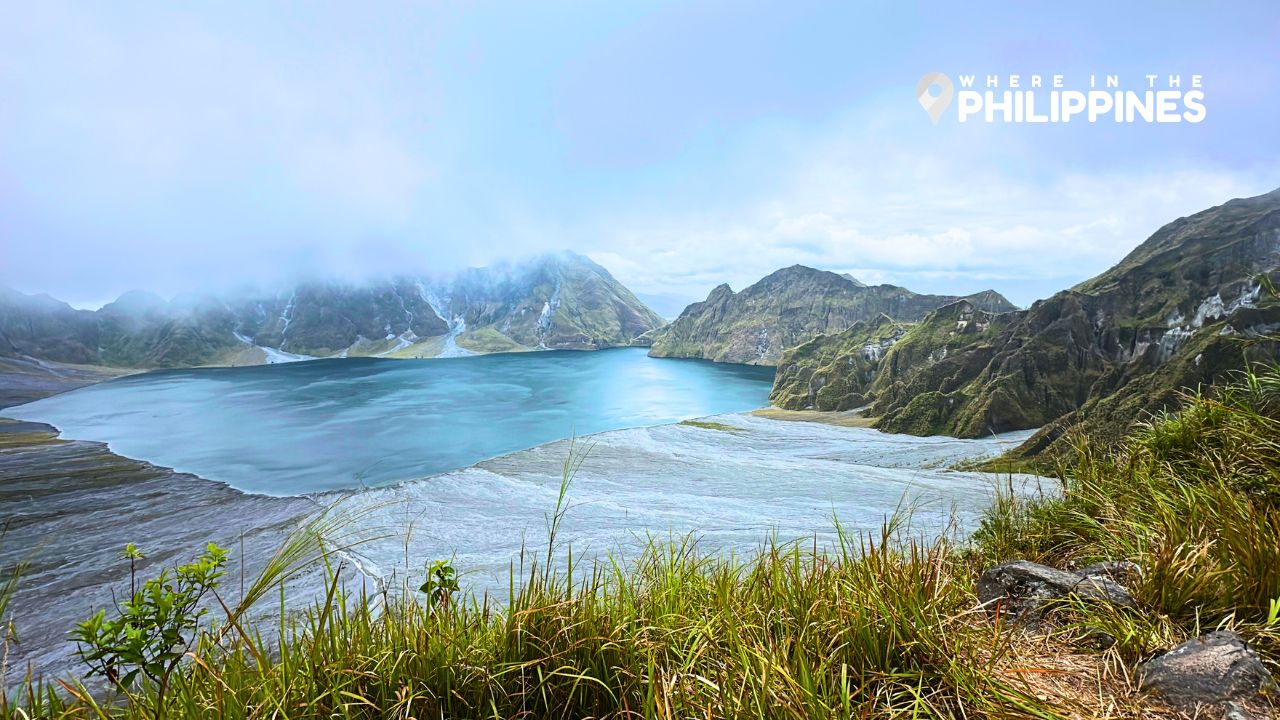
Mount Pinatubo officially reopened in June 2025 after a temporary closure, with new tour policies and sustainable practices in place. The tour begins with an exhilarating 4×4 ride across the lahar plains — an otherworldly landscape of ash-gray valleys and sharp ridges. From the jump-off, the hike to the crater takes about 1.5 hours one way. The trail is beginner-friendly (rated 2 out of 9 for difficulty) but heat-intensive — an early 4–5 AM departure is essential. At the top, you’re rewarded with a turquoise-green crater lake surrounded by dramatic cliffs. Swimming is prohibited, but the view is unforgettable.
Foreign visitors need Philippine Air Force clearance applied for at least 20 days in advance. [Klook hook: book your Mount Pinatubo tour]
Mount Arayat National Park — The Province’s Own Backyard Mountain
Mount Arayat was declared a national park in the 1930s and remains Pampanga’s most accessible hiking destination. Less crowded than Pinatubo, easier to reach independently, with hot springs at the base and forest trails through the mountain. The views of the flat Central Luzon plain from the slopes are worth the climb.
Sandbox at Alviera — For the Thrill-Seekers
Sandbox holds the tallest giant swing in the Philippines and Asia’s first rollercoaster zipline, plus ATV rides, aerial walks, and wall climbing. A full-day destination for groups and adrenaline seekers, open Tuesday to Sunday, 9 AM to 5 PM. [Klook hook: book Sandbox activities]
Sky Ranch San Fernando — Family Day Done Right
Behind SM City San Fernando, Sky Ranch features over 20 rides anchored by the Pampanga Eye — a 65-meter Ferris wheel, one of the tallest in the Philippines — with panoramic views of the city and mountains. An easy, enjoyable half-day for families.
Aqua Planet — The Waterpark the Whole Family Will Love
Aqua Planet is one of the biggest and most modern water parks in Asia, located in Clark Freeport Zone with over 38 slides and water attractions. Best visited during the hot season from March to May.
History and Heritage in Pampanga
Betis Church — The Sistine Chapel of Pampanga
Built in the late 1600s, Betis Church is considered a National Cultural Treasure, recognized for its Baroque artistry and trompe-l’œil paintings. The ceiling murals and retablo woodcarving are extraordinary. Visit late afternoon and combine it with a heritage walk.
Bacolor Church — Half-Buried and Still Standing
When Mount Pinatubo erupted in 1991, lahar flows buried San Guillermo Parish up to its lower walls. Only the upper portion remains above ground. It still functions as an active parish — and standing in front of it tells you more about the 1991 eruption than any exhibit can.
Clark Museum and Museo ning Angeles — For History Buffs
The Clark Museum covers the transformation of the area from US military base to economic zone. Museo ning Angeles, in a 1920s neoclassical building in Angeles City, covers local Kapampangan history, traditional clothing, and cuisine. Both are low-cost and explorable in a single afternoon.
Pamintuan Mansion — Where Independence Was Celebrated
This Spanish-era heritage home in San Fernando is where President Emilio Aguinaldo celebrated the first anniversary of Philippine independence in 1899. Period antiques and social history exhibits fill the rooms. A guided tour, if available, is worth it.
The Giant Lantern Festival — Why San Fernando Is the Christmas Capital of the Philippines
If you can only visit Pampanga once and you have flexibility in timing, go in December.
The Giant Lantern Festival — the Ligligan Parul, or “Lantern Showdown” in Kapampangan — is an annual competition in San Fernando where barangays compete to create the most spectacular giant Christmas lanterns. These stand up to 20 feet in diameter and are illuminated by 5,000 to 10,000 light bulbs, controlled through a manual rotor system that creates synchronized, dancing light shows set to music.
No computers. Just decades of craft passed down through lantern-making families.
What Makes the Ligligan Parul Unlike Any Festival in the Philippines
Each barangay spends the better part of a year building its entry. In 2025, Barangay Bulaon claimed their first-ever championship, with an 18-year-old female lantern maker making history as the youngest in the competition. The festival continues to push toward sustainability — 2024 required entries to use at least 30% LED materials.
When It Happens and How to Plan Your Visit
The main competition night is a Saturday in mid-December at Robinsons Starmills, San Fernando. Exhibition nights run through January 1. Arrive by mid-afternoon to secure a good viewing spot, and use Night Mode on your phone — flash ruins both the photos and the crowd experience. The festival is free.
Where to Stay in Pampanga
[Agoda hook: browse accommodations in Pampanga]
Staying in Angeles City and Clark — Best for Most Travelers
Clark’s strong selection of mid-range to upscale hotels — Hann Resorts, Widus Hotel, Holiday Inn Clark — makes it the most practical base for most visitors, especially those doing the Mount Pinatubo tour (most operators are Clark-based). Budget options are widely available in Angeles City proper.
Staying in San Fernando — Best for the Giant Lantern Festival
Microtel by Wyndham San Fernando and Best Western Bendix Hotel are solid mid-range options near the festival venue. Book early — accommodations fill up fast for December.
Budget vs. Mid-Range vs. Resort — What to Expect
Budget rooms run ₱800–₱1,500 per night. Mid-range options (₱2,500–₱5,000) typically include pools and breakfast. For a resort experience like Abe’s Farm in Magalang — countryside accommodations, spa, and outstanding Kapampangan food under one roof — expect ₱6,000 and above.
How to Get to Pampanga
By Car via NLEX — The Most Convenient Option
From Metro Manila, the drive via the North Luzon Expressway to Angeles City or San Fernando takes 1 to 1.5 hours under normal traffic. Toll fees run approximately ₱150–₱250 each way.
By Bus from Manila — Routes, Terminals, and What to Expect
Victory Liner and Bataan Transit run regular services from Cubao, Pasay, and Caloocan. Fare is roughly ₱100–₱150 one way. Travel time is 1.5 to 2 hours. From drop-off points along the highway, tricycles and jeepneys cover local distances.
Via Clark International Airport — For Those Flying In
Clark International Airport (CRK) connects to domestic destinations including Cebu and Davao, and some international routes. Flying into Clark instead of NAIA is a genuinely good option for travelers coming from outside Luzon — it puts you directly in the province and bypasses Manila traffic entirely.
Best Time to Visit Pampanga
November to February is the sweet spot — cool, dry weather ideal for hiking, heritage walks, and outdoor activities.
December is the month for the Giant Lantern Festival. Book accommodations early.
March to May is the hottest period. The Pinatubo hike is still doable but demands an even earlier start. Water parks are at their most appealing.
Holy Week (March or April) brings the Maleldo — a deeply serious religious reenactment of the Passion of Christ in San Fernando, with some devotees going as far as actual crucifixion. It draws observers from around the world. Approach with respect and cultural sensitivity.
Pampanga Travel Tips
[Lazada/Shopee hook: travel essentials for your Pampanga trip]
- NLEX traffic peaks on Friday afternoons and Sunday evenings. Leave Manila before 7 AM or after 9 PM on weekends.
- Local transport: Grab is available in Angeles City, Clark, and San Fernando. Tricycles cover short distances. Jeepneys handle longer local routes.
- Cash: Many local restaurants and market stalls don’t take GCash. Bring physical cash. ATMs are widely available in major areas.
- For the Pinatubo hike: wear closed, waterproof shoes — river crossings are part of the trail. Bring significantly more water than you think you need.
- What to pack: light breathable clothing, a jacket for December evenings, reef-safe sunscreen, a reusable water bottle, and comfortable walking shoes.
Frequently Asked Questions About Pampanga
What is Pampanga known for?
Pampanga is best known as the Culinary Capital of the Philippines — home to sisig, kare-kare, morcon, and many of the country’s most beloved dishes. It’s also the Christmas Capital of the Philippines for the Giant Lantern Festival, and a base for the Mount Pinatubo hike.
Is Pampanga worth visiting?
Absolutely. Whether you’re coming for the food, the festivals, the adventure, or the heritage, Pampanga consistently delivers. It’s one of the most rewarding provinces to visit in Luzon — and it’s close enough to Manila for a weekend trip.
How far is Pampanga from Manila?
About 80 kilometers north. By car via NLEX, 1 to 1.5 hours. By bus from major Manila terminals, 1.5 to 2 hours.
What are the must-try foods in Pampanga?
Sisig (go to Aling Lucing’s for the original), kare-kare, morcon, bringhe, tibok-tibok, and taba ng talangka. For the adventurous: betute (stuffed frog) and camaru (fried crickets).
Where are the best restaurants in Pampanga?
Aling Lucing’s Sisig, Bale Dutung, Apag Marangle, Everybody’s Café, and Susie’s Cuisine are the most consistent and well-regarded options for authentic Kapampangan dining.
When is the Giant Lantern Festival in Pampanga?
Annually in December in San Fernando. Main competition is a Saturday in mid-December. Exhibitions run through January 1 at Robinsons Starmills. Free admission.
What are the top tourist spots in Pampanga?
Mount Pinatubo, Mount Arayat National Park, Betis Church, Bacolor Church, Sandbox at Alviera, Sky Ranch San Fernando, Aqua Planet, Clark Museum, and Pamintuan Mansion.
Is Angeles City part of Pampanga?
Technically no — Angeles City is an independent highly-urbanized city with its own government, separate from the province. But for travelers, it functions as Pampanga’s most visited urban hub and the best base for exploring the province.
How do I get to Pampanga from Manila?
By car via NLEX (1–1.5 hours), by bus from Cubao, Pasay, or Caloocan (1.5–2 hours, ₱100–₱150), or by flying into Clark International Airport (CRK) if coming from outside Luzon.
What is the best area to stay in Pampanga?
Angeles City and Clark for most travelers. San Fernando if you’re visiting specifically for the December Giant Lantern Festival.